Lanchonete invites 32 guest artists from around the world and different parts of Brazil into a time- and site-specific artist residency project in the center of São Paulo.
Lanchonete is a place and a project. The overall project lasts five years, and consists of two phases lasting two-and-a-half years each. The first phase, building a platform of support and solidarity, is a prerequisite to inhabiting a physical lanchonete during the second phase.
In the center of São Paulo, and across the vast city, the lanchonete (or lunch counter) is one of the only places where people in different economic classes share middle ground. Unlike new-construction-restaurants, lanchonete in the older part of the city typically have open fronts – or corners – rather than doors, making them porous and easy to enter or pass through. These ubiquitous lunch counters and their longstanding tradition present an alternative to the homogenizing effect of advanced gentrification on public space.
The lanchonete will have a staff and operate as a business; 32 international and Brazil-wide artists-in-residence will live in a suite of adjacent apartments for periods of four months each, four at a time. Local artists and cultural organizers will join the project through residency and publications activities co-produced with
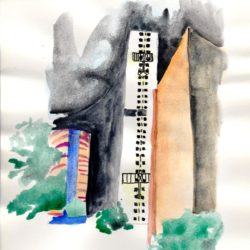
PIVÔ art space in the bottom of the historic
Copan Building. The lanchonete, residency apartments and
PIVÔ form a triangle of urban space. This urban corridor is the space of the Lanchonete artist residency, with the restaurant serving as the nucleus (or power source) of the project.
The five-year duration of Lanchonete is both ephemeral and enduring long enough to take necessary risks and serve as a station of witness in a fast-changing neighborhood for which population growth and change have outpaced urban planning.
As the major cities of the world move from limited to contested space for a variety of reasons (e.g. rural to urban migration, immigration, forced mobility, traffic jams, beautification projects, and the exorbitant prices paid for convenience) and because those institutions, groups and people with the most agency and means get priority access to prime real estate, a simple question must be asked: Can diverse neighborhoods persist and survive near epicentres of capital?
Lanchonete asks that question in a different way:
If artists are empowered to innovate on a large enough scale to interrupt the status quo, what would that look like?